Primary Color Wheel
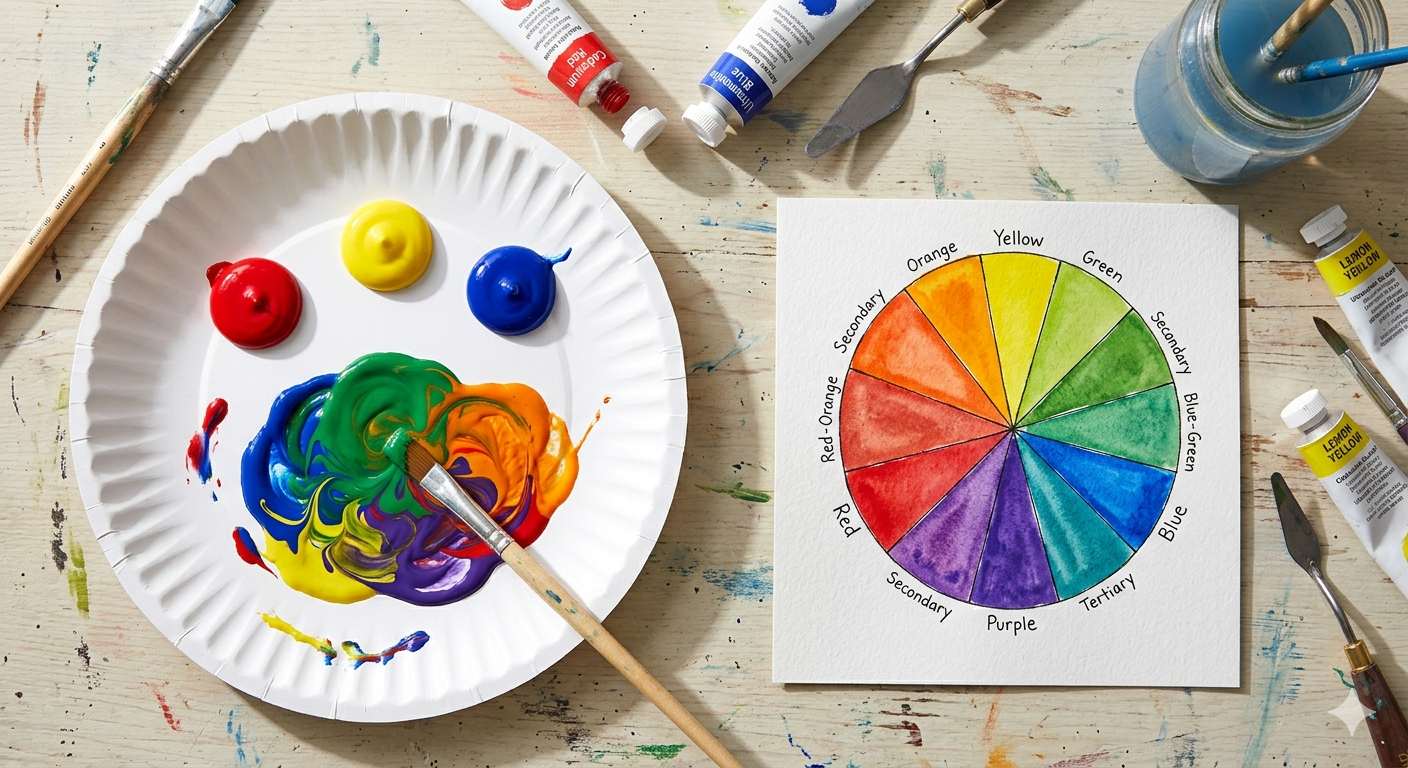
There is something genuinely magical about watching a child realize that mixing yellow and blue paint creates bright green. To adults, color theory is basic science, but to a young child, it feels like a superpower. Teaching kids how to create an entire spectrum of colors using only red, yellow, and blue is one of the most foundational, rewarding art projects you can introduce in a classroom or at home.
A primary-colors-only color wheel lesson plan introduces children to the fundamentals of art, helps build fine motor skills, and fosters scientific inquiry through hands-on experimentation. However, teaching a 3-year-old requires a completely different approach than teaching a 10-year-old.
This comprehensive guide offers a scalable, low-prep color wheel lesson plan designed to engage children across a wide age range, ensuring that every child experiences the joy of color discovery.
Why Limit the Palette to Primary Colors?
It can be tempting to set out a massive tray of pre-mixed green, orange, and purple paints to make things easier. However, restricting your materials to just the three primary colors (Red, Yellow, and Blue) plus white offers immense educational value:
Teaches Problem Solving: If a child wants to paint an orange carrot but only has red and yellow, they must actively figure out how to create that color.
Builds Core Color Theory Knowledge: Experiencing color formulation firsthand cements the concept of primary and secondary colors far better than looking at a chart.
Encourages Resourcefulness: Children learn that they do not need expensive, massive art kits to create vibrant, diverse masterpieces.
Scaffolding the Lesson: Adapting for Ages 3 to 10
The beauty of a color wheel project is its adaptability. Here is how you can tailor this single lesson plan to fit different developmental stages without changing your core supplies.
For Toddlers and Preschoolers (Ages 3-5)
At this stage, the focus should be heavily on sensory exploration and basic color recognition rather than a perfect, geometric wheel. Avoid stressing over clean lines.
Instead of a complex 12-part circle, give younger kids a simple layout with three distinct sections or circles for the primary colors, and blank spaces in between. Focus on the vocabulary: Red, Yellow, Blue, Mix, and Change. Finger painting or using large, chunky stamps is excellent for this age group to develop hand strength.
For Early Elementary Students (Ages 6-8)
Children in this bracket are developing better spatial awareness and fine motor control. They can easily grasp a standard 6-part color wheel (Primary colors: Red, Yellow, Blue; Secondary colors: Orange, Green, Purple).
Incorporate simple fractions or math language into the mix: "What happens if we mix one scoop of red with one scoop of yellow?" Instruct them on how to rinse their brushes thoroughly between steps to prevent the entire wheel from turning into a muddy brown.
For Upper Elementary Students (Ages 9-10)
Older kids are ready for a challenge. You can introduce a full 12-part color wheel that includes tertiary colors, such as blue-green or red-orange.
Challenge them to experiment with value and intensity by introducing a small dollop of white paint to create tints. This group can focus on precise brushwork, clean mixing practices, and understanding the relationship between complementary colors (colors opposite each other on the wheel).
Simple Materials List
You do not need a massive budget for this engaging art lesson. Gather these basic, low-prep supplies:
Heavy-weight paper: Mixed media or watercolor paper works best to prevent warping.
Primary paints: High-quality washable tempera or acrylic paint in True Red, True Yellow, and Royal Blue.
Paintbrushes: Large round brushes for little hands; medium pointed rounds for older kids.
Mixing palettes: Paper plates, plastic trays, or recycled jar lids work beautifully.
Water cups and paper towels: Essential for keeping brushes clean between color transitions.
A circle template: A printed outline of a color wheel divided into 6 or 12 segments (depending on age).
Step-by-Step Color Wheel Lesson Plan
Step 1: The Primary Anchor Points
Start by placing the three primary colors on the wheel. Instruct the children to paint the Red, Yellow, and Blue segments first, leaving even, blank spaces between them. Explain that these are the "boss colors" because they cannot be made by mixing any other colors together.
Step 2: Conquering the Secondaries
Once the primary anchors are painted, it is time for the magic to happen.
Direct the children to mix equal parts of Yellow and Blue on their palette to create Green. Paint this in the space right between Yellow and Blue.
Next, mix Yellow and Red to create Orange, placing it between those two anchors.
Finally, mix Red and Blue to create Purple (Violet), filling the final gap.
Step 3: Tertiary Exploration (Optional for Ages 9-10)
If working with older children, show them how to take a secondary color and add a little more of an adjacent primary color to create shades like yellow-green or red-orange, filling out a complete 12-part wheel.
Step 4: Reflection and Discussion
While the paint dries, wrap up the lesson with a few engaging questions to reinforce what they learned:
"Which two colors made green?"
"What happens if you accidentally mix all three primary colors together?" (Spoiler: They will discover it makes brown!)
"Where do you see these color combinations in nature?"
Top Tips for a Mess-Free (and Stress-Free) Art Session
Manage the Paint Portions: Kids love to squeeze out huge puddles of paint. Provide only a nickel-sized dollop of each primary color at a time. It minimizes waste and keeps mixing controlled.
Embrace the Mud: At least one child will inevitably mix everything together into a dark grey or brown puddle. Do not worry! Frame it as a scientific discovery about neutralizing colors. Give them a fresh sheet of paper and let them try again.
Pre-tape the Paper: Use painter's tape to secure the color wheel template to the table. This keeps the paper from sliding around while young artists focus on controlling their brush strokes.