Pipe Cleaner and Pom-Pom Animal
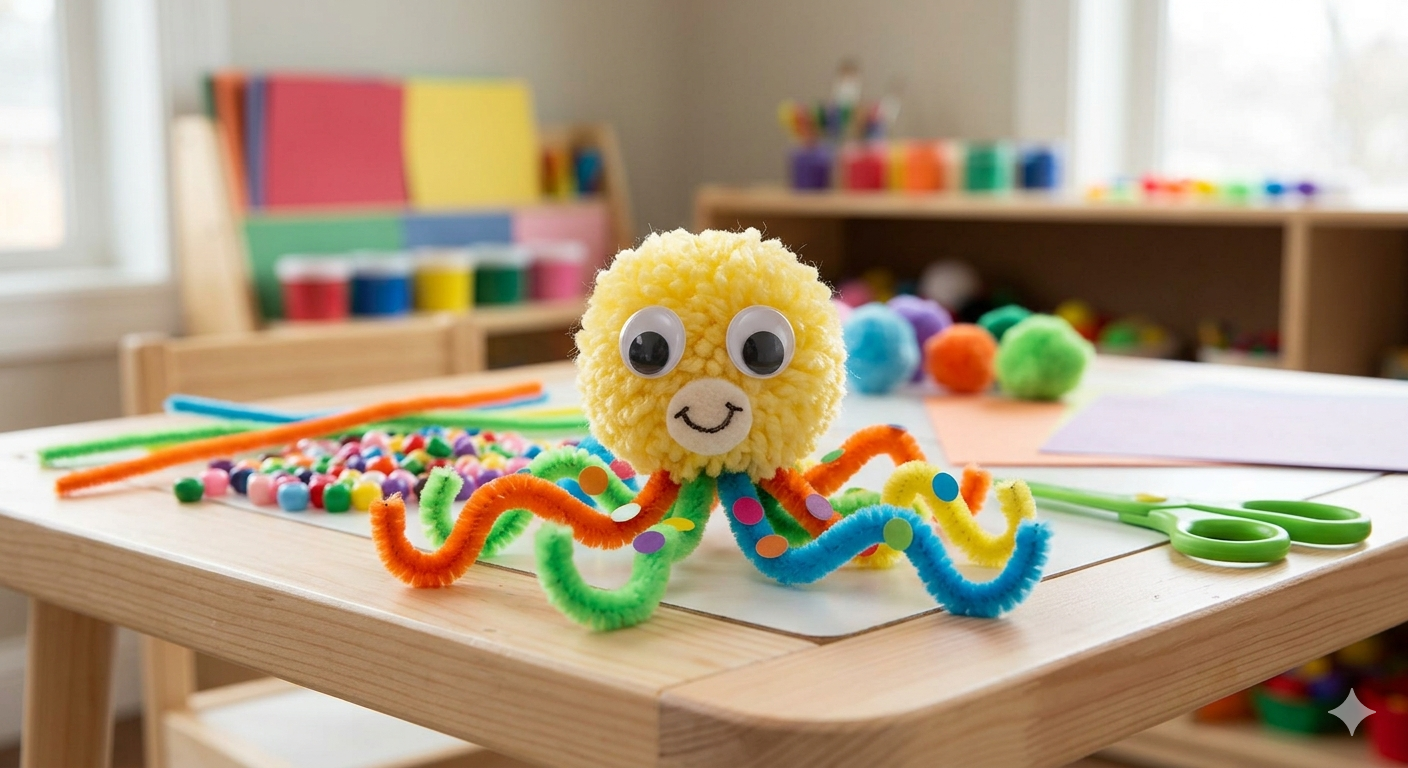
Finding a hands-on activity that simultaneously captivates a chaotic 3-year-old and challenges an analytical 10-year-old is a rare victory. Enter the humble pipe cleaner and pom-pom. This classic crafting duo does more than just keep hands busy; it serves as a powerful, multi-sensory educational tool.
Whether you are a classroom teacher building a STEAM (Science, Technology, Engineering, Art, and Math) unit or a parent looking for a rainy-day project, this comprehensive lesson plan is designed to scale. It adapts seamlessly to different developmental stages while keeping preparation time under ten minutes.
Why This Lesson Plan Works: The Developmental Benefits
Before diving into the glue and fuzz, it helps to understand why this specific craft packs such an educational punch.
1. Fine Motor Skill Cultivation (Ages 3-5)
For preschoolers, threading a pipe cleaner or squeezing a glue bottle is a workout for the small muscles in the hands. This is known as fine motor development. Twisting the wires and pinching small pom-poms strengthens the exact muscles required for pencil grip and scissor cutting later on.
2. Spatial Awareness and Engineering (Ages 6-8)
As children enter early elementary school, the challenge shifts from manipulation to structural engineering. How do you make a heavy pom-pom head stand up on four thin pipe cleaner legs? Children must naturally experiment with balance, center of gravity, and structural support.
3. Open-Ended Creative Taxonomy (Ages 9-10)
Older kids transition from following simple steps to using critical thinking. They can dive into animal taxonomy—classifying their creations as vertebrates, invertebrates, mammals, or arthropods. The craft becomes a physical manifestation of biological concepts.
The Master Lesson Plan: “Build an Animal"
Lesson Overview
Target Age Group: 3 to 10 years old (with age-appropriate modifications)
Time Duration: 45 to 60 minutes
Core Objectives: Develop fine motor skills, explore structural balance, and apply creative engineering to build a 3D animal model.
The Materials Checklist
One of the best features of this lesson plan is its low cost. You do not need expensive kits—just basic crafting staples.
Yarn Pom-Poms: Used for animal bodies, heads, and tails in various sizes. (Eco-friendly alternative: Felted wool balls or rolled scrap fabric)
Chenille Stems (Pipe Cleaners): Used for creating legs, antennae, wings, and structural spines. (Eco-friendly alternative: Twisted paper raffia with internal wire)
Googly Eyes: Provides visual personality and focal points. (Eco-friendly alternative: Paper cutouts drawn with markers)
Craft Glue / Dots: Essential for securing pieces together. (Eco-friendly alternative: Homemade flour-and-water paste)
Step-by-Step Activity Guide
To make this lesson a success, follow this sequential structure. The key is allowing the children to drive the design process while you provide the structural scaffolding.
Introduction & Brainstorming: 10 Minutes.
Gather the children and ask them to choose an animal. Discuss that animal's physical traits. Does it have four legs or six? Does it need wings? A long tail? This step grounds the abstract craft in real-world biology.
Material Selection & Planning: 5 Minutes.
Have the kids select their color palette and sizes. Prompt them to think about proportion: “If you are building an elephant, do you need a giant pom-pom for the body and smaller ones for the ears, or vice versa?”
Building the Core Skeleton: 15 Minutes.
Instruct the children to create the spine or legs using pipe cleaners first. For younger kids, this might just be bending a single pipe cleaner in half to make two legs. For older kids, it involves twisting multiple stems together to create a sturdy, freestanding four-legged chassis.
Fleshing Out the Body: 15 Minutes.
Attach the pom-poms to the wire skeleton. You can wrap the pipe cleaner around the center of the pom-pom to hold it securely without glue, or use liquid craft glue/glue dots for extra stability. Add the eyes and any secondary features like ears or wings.
The Stability Test & Presentation: 10 Minutes.
Place the finished animals on a flat surface. Do they stand up? If an animal tips over, help the child analyze why. Is the head too heavy? Are the legs uneven? Adjusting the wire bends teaches basic physics and resilience.
Age-Appropriate Scaffolding: How to Adapt the Plan
A single instruction style will not work for both a toddler and a fourth-grader. Use these tier adaptations to keep everyone engaged.
The Preschool Tier (Ages 3-4)
The Reality: They will struggle with twisting wire tightly and will want to use far too much glue.
The Strategy: Keep it simple. Focus on bugs or caterpillars. Have them slide large wooden beads or thread small pipe cleaners directly through a sequence of pre-pierced pom-poms. Alternatively, have them wrap a single pipe cleaner around one giant pom-pom to make a "spider."
The Early Elementary Tier (Ages 5-7)
The Reality: They want their animals to look realistic but can get frustrated when the legs collapse under the weight of the torso.
The Strategy: Introduce the concept of a "double-fold." Teach them to fold the pipe cleaner in half to double its thickness, making the legs twice as strong. Encourage them to build familiar animals like dogs, cats, or birds.
The Upper Elementary Tier (Ages 8-10)
The Reality: Simple animals will bore them quickly.
The Strategy: Introduce constraints and advanced concepts. Challenge them to build mythical creatures (like dragons or griffins) or specific biomes (like deep-sea creatures with bioluminescent features). Require their animals to have moving parts, such as a tail that wags or wings that expand using clever wire hinges.
Pro-Tip for Educators: When working with liquid school glue, teach the "dot, dot, not a lot" rule. Excessive glue bogs down the fluff of the pom-poms and multiplies the drying time, which can test the patience of younger creators.
Cleaning Up and Reflection
Wrap up the lesson by turning the cleanup process into a game of color-sorting sorting (putting red pipe cleaners in one bin, blue pom-poms in another). Once the workspace is clean, have each child share one thing about their creature. Ask them what was hardest about making it stand up. This final reflective step solidifies the engineering and problem-solving lessons they learned along the way.