Q-Tip Dot Flower Painting
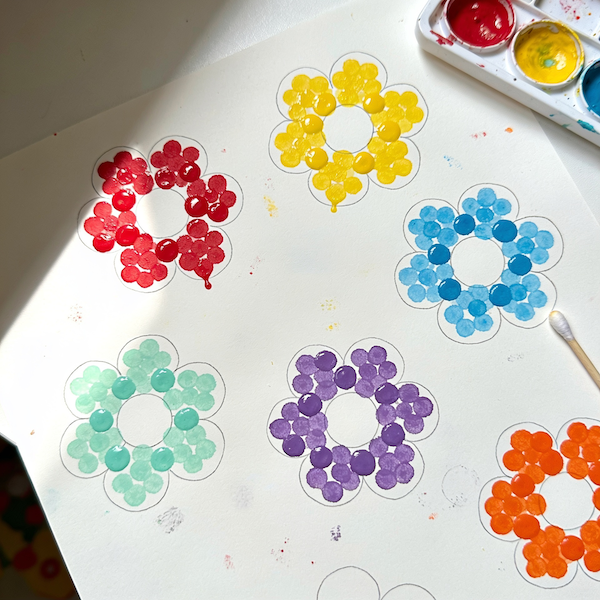
A mess-friendly, skill-building art activity that sparks creativity and grows with your child.
Spring is in the air, and there's no better way to bring it indoors than with a cheerful field of flowers — painted entirely with Q-tips! This simple, screen-free art lesson is perfect for kids ages 3 to 10, requires minimal supplies, and delivers maximum joy. Whether you're a parent planning a weekend activity, a preschool teacher looking for a new project, or a homeschool educator building a unit around nature and color, this Q-tip dot painting lesson has everything you need.
Let's dig into the why, the how, and the wow of this beloved kids' art technique.
Why Q-Tip Dot Painting Is Perfect for Kids
Before we get to the lesson plan, it's worth understanding what makes Q-tip painting such a powerhouse activity for child development.
Fine motor skills. Gripping a Q-tip and pressing it precisely onto paper requires the same pincer grasp that children use for writing. For toddlers and preschoolers, this is valuable pre-writing practice wrapped in fun.
Color theory made simple. Dot painting naturally invites children to experiment with mixing colors. What happens when a yellow dot overlaps a blue one? Curiosity leads to discovery.
Low frustration, high reward. Unlike brushes, Q-tips are forgiving. There's no wrong pressure, no streaks, no "ruined" painting. Every dot is a success — which builds confidence in young artists.
Scalable complexity. A 3-year-old can happily fill a circle with dots. A 10-year-old can design detailed petals, blend gradient colors, and plan a full landscape composition. This activity truly grows with the child.
What You'll Need
Gather these supplies before you begin — most are likely already in your home:
Q-tips (one per color, or a small bundle per child)
Tempera paint or washable craft paint in multiple colors (red, yellow, pink, purple, orange, green, white)
Cardstock or heavy watercolor paper (standard printer paper works in a pinch)
A paper plate or paint palette for holding paint
A pencil (optional, for light sketching outlines)
A black marker (optional, for older kids who want defined outlines)
A smock or old shirt to protect clothing
Damp paper towels for cleanup
Pro tip: Pour paint into shallow bottle caps or the wells of a muffin tin to keep colors separated and easy to access for little hands.
Lesson Plan: Q-Tip Dot-Painted Field of Flowers
Learning Objectives
By the end of this activity, children will:
Practice fine motor control and hand-eye coordination
Explore color mixing and color relationships
Build creative confidence through open-ended art-making
Observe and represent elements from nature
Part 1: Introduction and Inspiration (5–10 minutes)
Start by sparking curiosity. Show children real flowers or photos of flower fields — sunflower meadows, wildflower gardens, and poppy fields are especially vibrant and inspiring. Ask open-ended questions:
"What colors do you see in this flower?"
"How many petals does this one have?"
"What shapes can you spot?"
For older children (ages 7–10), briefly introduce the concept of pointillism — the art technique used by painter Georges Seurat, where tiny dots of color are placed close together to create an image. Show a simple example. This gives the activity an exciting art-history context and makes kids feel like real artists.
Part 2: Setting Up the Canvas (5 minutes)
For ages 3–5: Pre-draw simple flower outlines (circles for the centers, petal shapes around them) lightly in pencil. Children fill the shapes with dots of color. Add a wavy green line across the bottom to represent grass.
For ages 6–8: Let children sketch their own basic flower shapes. Encourage a mix of sizes and types — tall sunflowers, round daisies, little wildflowers.
For ages 9–10: Challenge them to design the full composition independently: foreground flowers large and detailed, background flowers smaller and less defined to create a sense of depth.
Part 3: Dot Painting Time! (20–30 minutes)
Now the real fun begins. Here's a step-by-step painting guide:
Start with the flower centers. Dip a Q-tip into yellow or orange paint and dot the center circles. Encourage children to fill them in fully with tight, overlapping dots.
Add the petals. Choose petal colors and dot outward from the center. Remind kids they can layer dots — a pink dot on top of a white dot creates a soft highlight.
Paint the stems and leaves. Use a fresh Q-tip dipped in green paint to create stems (a line of connected dots) and leaf shapes (dots arranged in an oval cluster).
Fill the background sky. Light blue or lavender dots in the upper portion of the paper create a sky. White dots add the feel of sunlight.
Create the ground. Green dots in varied shades along the bottom half suggest a grassy meadow. Mix in yellow-green and dark green for variety.
Add details. Older children can add butterflies (simple dot-wing shapes), a sun, clouds, or even a bee. Every extra element makes the painting more personal.
Encourage children to use a fresh Q-tip when switching to a very different color — it keeps the palette bright and clean.
Part 4: Reflection and Display (5–10 minutes)
Once paintings are dry, gather children for a short gallery walk. Invite each child to share one thing they're proud of in their painting. This builds vocabulary around art, encourages observation, and validates their creative choices.
Display the finished paintings on a wall or bulletin board to create a full community flower field. The collective effect of many individual paintings side by side is genuinely stunning.
Age-Specific Tips at a Glance
Age Group, Focus, Suggested Complexity
Ages 3–4
Sensory exploration, gripping practice
Pre-drawn outlines, 2–3 colors
Ages 5–6
Shape recognition, color mixing
Simple self-drawn flowers, 4–5 colors
Ages 7–8
Composition, intentional color choice
Independent design, varied flower types
Ages 9–10
Depth, pointillism concepts, detail
Full landscape composition, 6+ colors
Extensions and Variations
Keep the creative momentum going with these fun add-ons:
Seasonal themes: Paint a snowy winter scene, autumn leaves, or a night-sky field with glowing fireflies using the same dot technique.
STEM connection: Count petals, sort flowers by color, or measure stem heights to weave math into the art lesson.
Sensory version: Add a small amount of sand or salt to the paint for a textured, tactile experience.
Digital display: Photograph the finished works and create a simple slideshow or class art book as a keepsake.
Final Thoughts
Q-tip dot painting is one of those rare activities that checks every box: developmentally appropriate, endlessly adaptable, easy to set up, and genuinely beautiful in its results. A field of flowers is the perfect subject — familiar, colorful, and full of creative possibilities for every age.
So pull out those Q-tips, lay down some newspaper, and let your little artists paint the world in bloom. The only rule? Every dot counts.
Happy painting! 🌸
Frequently Asked Questions (FAQs)
Q: What age is Q-tip dot painting appropriate for? Q-tip dot painting is suitable for children as young as 2–3 years old with supervision, all the way up to age 10 and beyond. The activity scales beautifully — younger children enjoy the sensory experience of dotting freely, while older kids can tackle more complex compositions and color techniques like pointillism.
Q: What kind of paint works best for Q-tip dot painting? Washable tempera paint is the top choice for kids — it's non-toxic, easy to clean, and comes in vibrant colors. Acrylic craft paint works well for older children and produces bolder, more defined dots. Avoid watercolor paint, as it's too thin and won't create the satisfying, opaque dots that make this technique so effective.
Q: How do I keep the activity from getting too messy? A few simple steps go a long way: lay down newspaper or a plastic tablecloth, use a smock or old t-shirt, and pour paint into muffin tin wells or bottle caps instead of opening full bottles. Keep a damp paper towel nearby for quick hand wipes. The good news? Q-tip painting is actually one of the tidier kids' paint activities — no drips, no big brushstrokes, no flung paint!
Q: How many Q-tips does each child need? A good rule of thumb is one Q-tip per color to keep colors clean and vibrant. For a project using 6 colors, set out 6 Q-tips per child. You can reuse Q-tips within the same color family (e.g., light pink and hot pink), but switch to a fresh one when moving to a very different hue.
Q: Can this lesson be done in a classroom setting? Absolutely! Q-tip dot painting is one of the most classroom-friendly art activities available. It requires minimal setup, uses inexpensive supplies, and can accommodate an entire class working simultaneously. Set up paint stations with pre-portioned colors, and the whole activity — including cleanup — fits comfortably into a 45-minute class period.
Q: What paper is best for this project? Cardstock or heavy drawing paper (at least 65 lb / 176 gsm) holds up best to the repeated pressing of paint-loaded Q-tips. Standard printer paper can buckle and tear with heavy dot coverage. Watercolor paper is a premium option that produces beautiful results. For a fun variation, try black cardstock — the bright paint colors pop dramatically against a dark background.
Q: How long does the painting take to dry? Tempera paint dots dry quickly — typically within 15 to 30 minutes at room temperature, depending on how thickly the paint was applied. Avoid stacking paintings before they're fully dry. For faster drying, lay paintings flat in a well-ventilated area or near a gentle fan.
Q: Can I use this activity to teach art history? Yes — and it's a wonderful connection! This project is a natural introduction to pointillism, a painting style developed by French Post-Impressionist artists Georges Seurat and Paul Signac in the 1880s. For children ages 7 and up, showing a print of Seurat's famous A Sunday on La Grande Jatte before the activity adds rich context and makes kids feel connected to a real artistic tradition.
Q: What if a child gets frustrated that their painting "doesn't look right"? Redirect their focus from the outcome to the process. Remind them that every dot is part of the picture, and that even professional pointillist paintings look like "just dots" up close. Encouraging phrases like "I love how you filled that whole flower center" or "Look at all the colors you used" shift attention to effort and choice rather than realism. There is truly no wrong way to dot-paint.
Q: Are there other subjects kids can paint using this same Q-tip technique? The possibilities are endless! Once kids have mastered flowers, try: butterflies, rainbows, animals (a dotted caterpillar is a favorite!), holiday themes like Christmas trees or pumpkins, abstract color patterns, self-portraits, or night-sky scenes with stars and a moon. The Q-tip dot technique works beautifully for any subject — it's a versatile skill kids can return to again and again.